



The holidays bring people together, and that means more hands on the same door handles, faucets and remotes. Germs travel the same way: from one person, to a surface, to the next person's hands, and from there to their eyes, nose or mouth.
This isn't a reason to panic. Viruses like COVID-19 spread mainly through the air, when people are near someone who is sick. Touching contaminated surfaces is a lower-risk route (Centers for Disease Control and Prevention [CDC], 2021). But it's the route you can do the most about at home, in a few minutes a day. In Part 1, we'll show you how germs move through a house. In Part 2, we'll give you a 10-minute evening reset that interrupts them.
How long germs last on surfaces 🧫
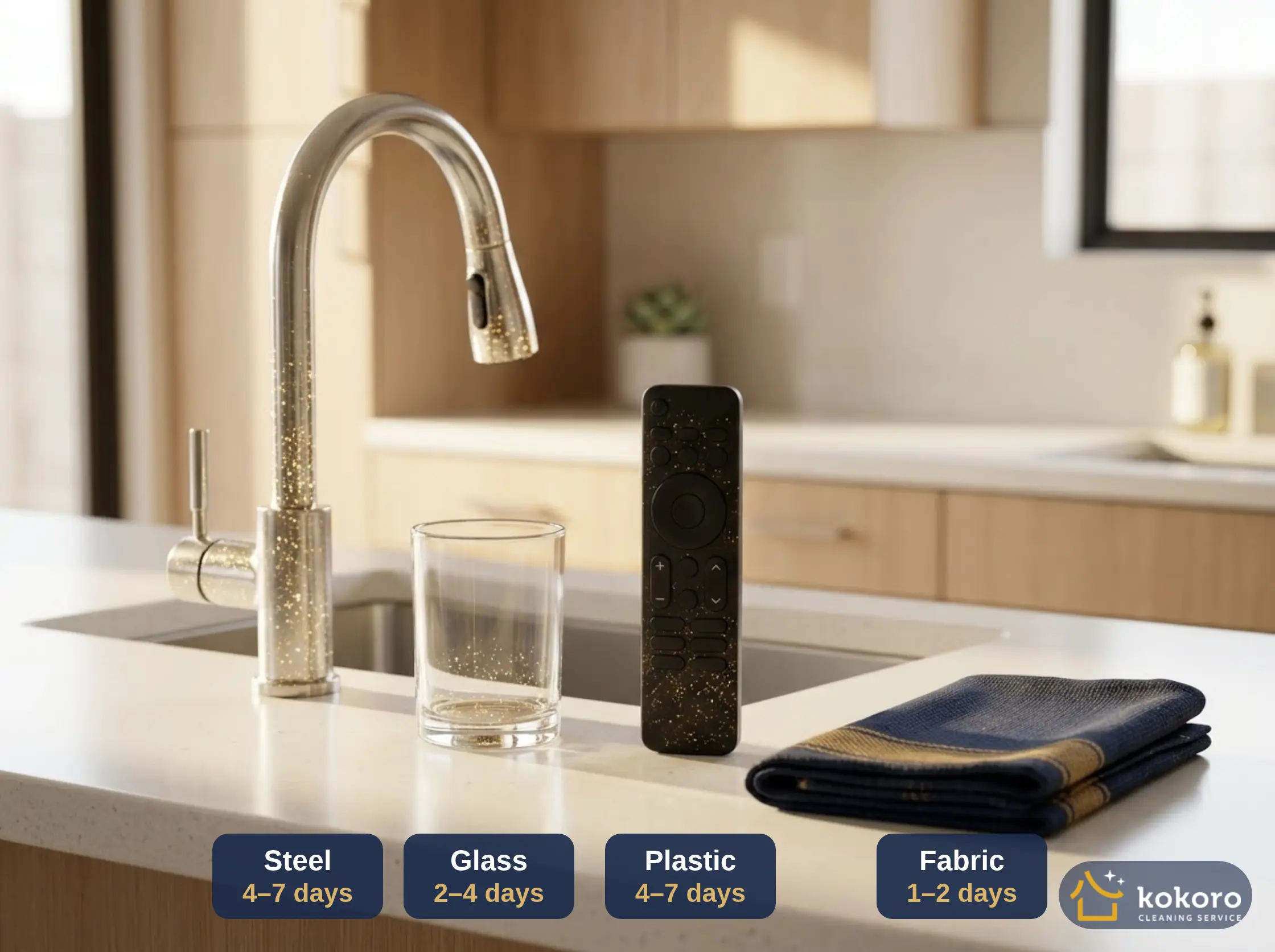
Everyday surfaces: steel, plastic, glass and fabric, which hold germs for different lengths of time.
On common hard surfaces under typical indoor conditions, the amount of infectious COVID-19 virus drops by about 99% within three days (CDC, 2021). Survival depends on the surface and the germ. Lab studies have found COVID-19 virus on plastic and stainless steel for about four to seven days, on glass for two to four, and on fabric for one to two. Flu viruses usually last hours to about a day on most surfaces (Zhang et al., 2024).
Cooler rooms extend those times. In one laboratory study, COVID-19 virus kept in the dark at room temperature, at a high starting concentration, was still detectable on glass and steel after 28 days (Riddell et al., 2020). Everyday homes have light, airflow and cleaning, so real-world survival is usually much shorter. Still, a surface touched on Monday can matter on Wednesday.
The five ways germs travel through your home

How germs travel along high-touch surfaces.
1. The bathroom-to-kitchen circuit. Hands that skip a proper wash carry germs from the bathroom door handle and faucet to the hallway light switch, then to the kitchen faucet and refrigerator. The kitchen, where food is handled, ends up holding what started in the bathroom.
2. The sick person's resting spot. When someone is sick, everything within arm's reach of where they rest becomes a reservoir: the remote, phone, blanket and nightstand. That's why the CDC advises people with respiratory symptoms to stay away from others, including the people they live with (CDC, 2025).
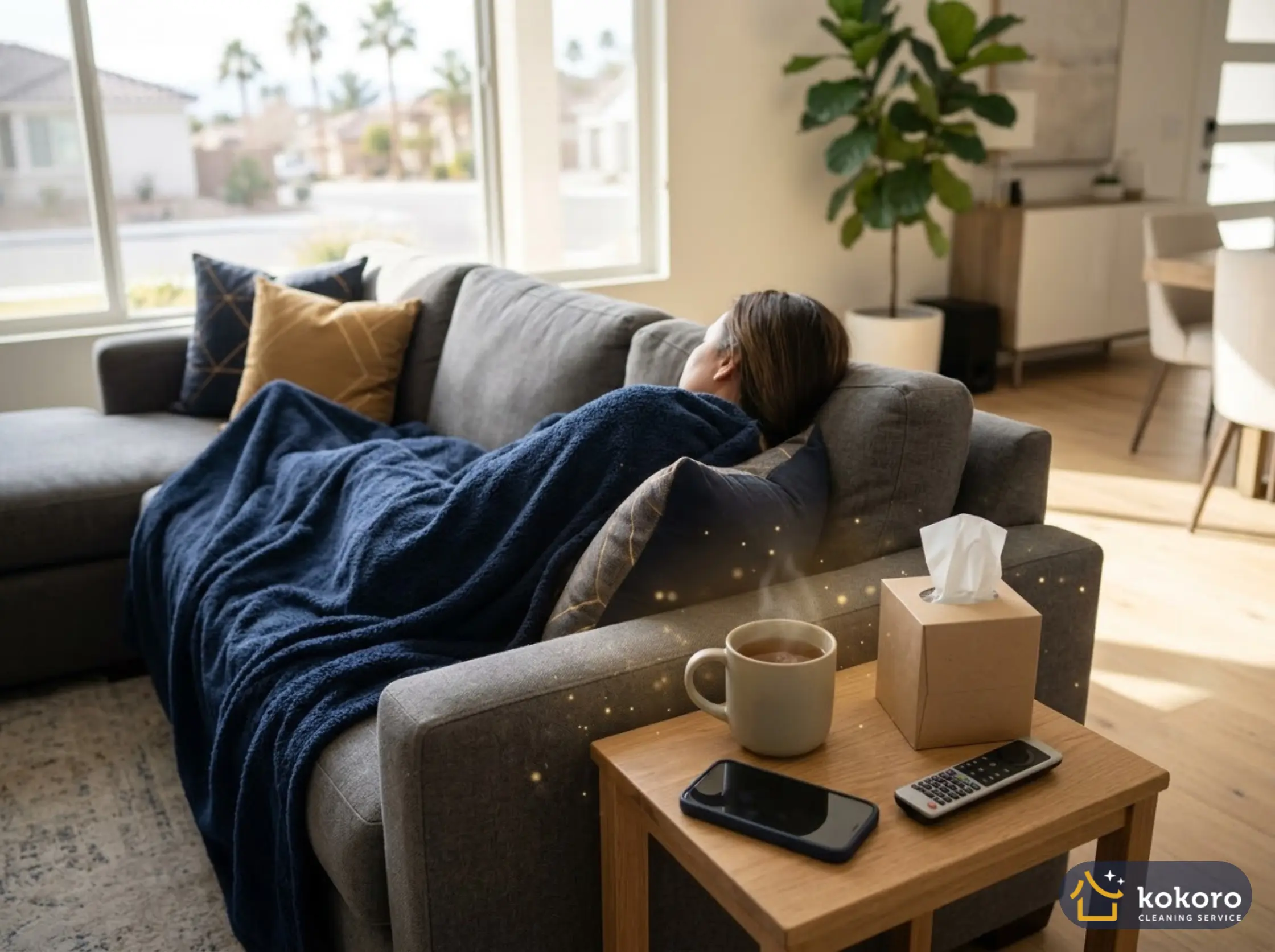
A sick family member spreads germs to whatever is within reach.
3. Kitchen cross-contamination. Raw meat juice on a cutting board reaches the knife handle, the counter edge, the hand towel and then your phone, all in one meal. Each touch moves germs one step further.

How germs move during meal prep.
4. The high-touch loop. In one study, researchers placed a harmless tracer virus on a single office door handle. It soon turned up on the break-room refrigerator, faucets and exit bars. When staff disinfected high-touch surfaces and used hand sanitizer, the virus found on hands and surfaces fell by about 85% (Kurgat et al., 2019). Homes work the same way, with fewer people sharing the same few handles.
5. Sneeze and settle. A single sneeze can release as many as 40,000 droplets, and a cough about 3,000 (Cole & Cook, 1998). Many settle on nearby surfaces: the lamp, the nightstand, the top of the TV.
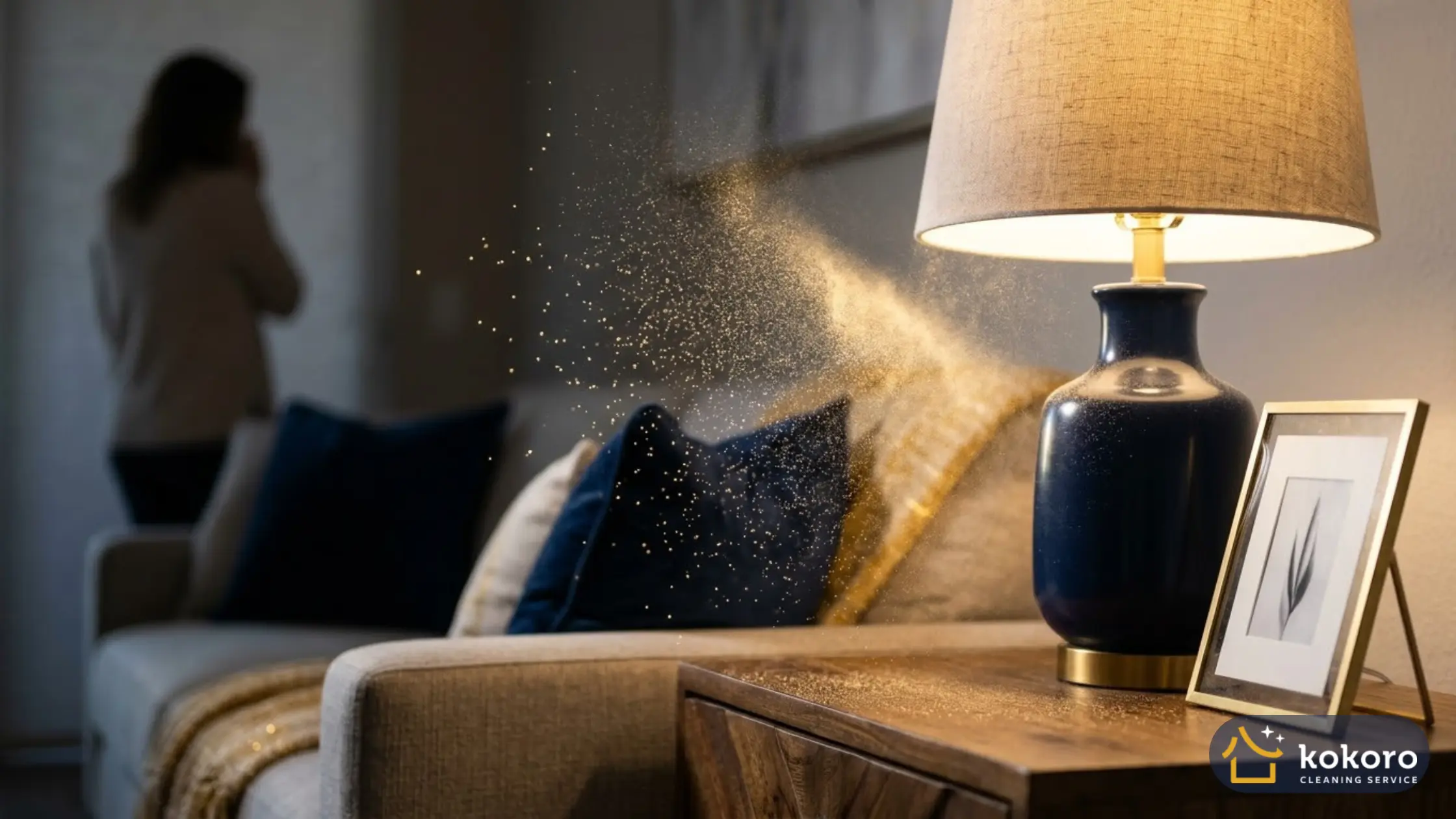
Droplets from a sneeze can settle on nearby furniture.
Your hands are the bridge

Hands near a face is the link between surfaces and infection.
Every pathway ends at the same place: a hand touching a face. One study found people touched their faces up to 23 times an hour, and 44% of those touches reached the eyes, nose or mouth (Kwok et al., 2015). Clean hands and clean high-touch surfaces break the chain at its two weakest links.
Coming in Part 2: the 10-minute evening reset, when to sanitize and when to disinfect, and what to do when someone gets sick.
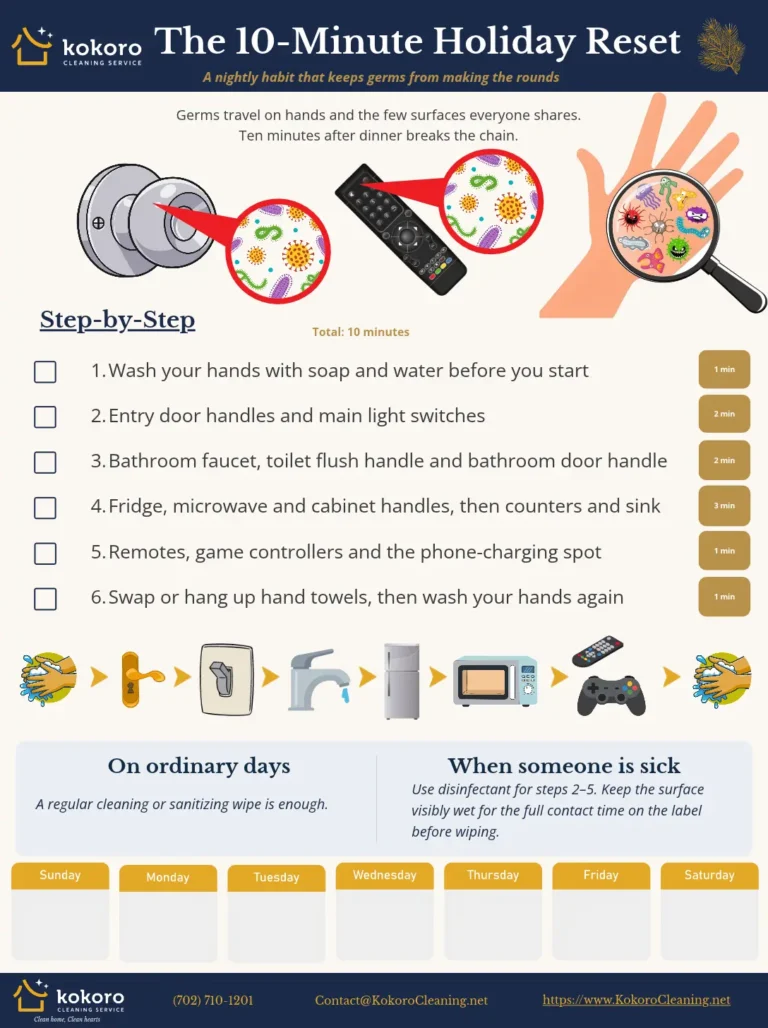
Want the checklist now? Download the free 10-Minute Holiday Reset guide.
References
Centers for Disease Control and Prevention. (2021, April 5). Science brief: SARS-CoV-2 and surface (fomite) transmission for indoor community environments. U.S. Department of Health and Human Services. https://stacks.cdc.gov/view/cdc/104762
Centers for Disease Control and Prevention. (2025, August 18). Preventing spread of respiratory viruses when you're sick. U.S. Department of Health and Human Services. https://www.cdc.gov/respiratory-viruses/prevention/precautions-when-sick.html
Cole, E. C., & Cook, C. E. (1998). Characterization of infectious aerosols in health care facilities: An aid to effective engineering controls and preventive strategies. American Journal of Infection Control, 26(4), 453–464. https://doi.org/10.1016/S0196-6553(98)70046-X
Kurgat, E. K., Sexton, J. D., Garavito, F., Reynolds, A., Contreras, R. D., Gerba, C. P., Leslie, R. A., Edmonds-Wilson, S. L., & Reynolds, K. A. (2019). Impact of a hygiene intervention on virus spread in an office building. International Journal of Hygiene and Environmental Health, 222(3), 479–485. https://doi.org/10.1016/j.ijheh.2019.01.001
Kwok, Y. L. A., Gralton, J., & McLaws, M.-L. (2015). Face touching: A frequent habit that has implications for hand hygiene. American Journal of Infection Control, 43(2), 112–114. https://doi.org/10.1016/j.ajic.2014.10.015
Riddell, S., Goldie, S., Hill, A., Eagles, D., & Drew, T. W. (2020). The effect of temperature on persistence of SARS-CoV-2 on common surfaces. Virology Journal, 17, Article 145. https://doi.org/10.1186/s12985-020-01418-7
Zhang, L., Fang, Z., Li, J., Huang, Z., Tie, X., Li, H., Li, J., Zhang, Y., Zhang, Y., & Chen, K. (2024). Research progress on environmental stability of SARS-CoV-2 and influenza viruses. Frontiers in Microbiology, 15, Article 1463056. https://doi.org/10.3389/fmicb.2024.1463056
More stories
All articles
How Holiday Germs Make the Rounds, Part 2: Your 10-Minute Evening Reset
In Part 1, we followed germs along five paths through a home. Every path runs through two things: hands and the surfaces they touch…
Read More : How Holiday Germs Make the Rounds, Part 2: Your 10-Minute Evening Reset
Allergen-Focused House Cleaning in Las Vegas
Puffy eyes in the morning. A scratchy throat every spring. Congestion in “dry desert air.” It isn’t your imagination.
Read More : Allergen-Focused House Cleaning in Las Vegas
Vacation Rental Floor Care by Surface
Every floor type has its own chemistry. Treat them all the same and you'll end up paying for it.
Read More : Vacation Rental Floor Care by Surface